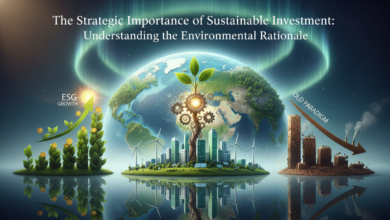
Strategic Evolution: Navigating Key ESG Investing Trends in 2026 Capital Markets

Introduction to the 2026 ESG Landscape
As we navigate the fiscal landscape of 2026, Environmental, Social, and Governance (ESG) criteria have transitioned from a specialized investment niche to a core pillar of global capital markets. Institutional investors and asset managers no longer view ESG as a secondary consideration but as a fundamental framework for risk mitigation and long-term value creation. The integration of sustainability metrics is now a standard requirement for maintaining market competitiveness and regulatory compliance.
[IMAGE_PROMPT: A modern high-tech financial trading room in 2026, featuring large transparent holographic displays showing green energy stock trends, carbon credit indices, and global sustainability data visualizations in a clean, professional aesthetic.]

1. Hyper-Transparency via AI and Real-Time Data Analytics
The most significant shift in 2026 is the move away from static, annual sustainability reports toward dynamic, real-time data monitoring. Artificial Intelligence (AI) and machine learning algorithms are now utilized to aggregate satellite imagery, supply chain IoT data, and social sentiment in real-time. This allows investors to verify corporate claims instantaneously, significantly reducing the risks associated with greenwashing and providing a more granular view of a company’s actual environmental impact.
2. The Rise of Nature-Positive Investing and Biodiversity Metrics
While carbon footprints dominated the discourse in the early 2020s, 2026 marks the era of nature-positive investing. Capital markets are increasingly valuing biodiversity as a critical asset class. New financial instruments, such as biodiversity credits and ecosystem service bonds, have emerged to facilitate investment in the restoration of natural capital. Investors are now utilizing standardized frameworks to measure how corporate operations affect local ecosystems, recognizing that biological health is intrinsically linked to economic stability.
[IMAGE_PROMPT: A professional corporate boardroom meeting where executives are analyzing a digital tablet displaying a 3D forest ecosystem model integrated with financial risk assessment charts, photorealistic, professional lighting, cinematic depth of field.]
3. Harmonization of Global Disclosure Standards
By 2026, the regulatory fragmentation that previously hindered cross-border ESG comparisons has largely been resolved. The consolidation of reporting standards under the International Sustainability Standards Board (ISSB) has provided a universal language for financial disclosures. This harmonization allows for more efficient capital allocation, as investors can now compare the ESG performance of a multinational corporation in Europe with a peer in Asia or North America using the same rigorous quantitative metrics.
4. Transition Finance and the Decarbonization of Heavy Industry
A major trend in 2026 is the strategic focus on ‘Transition Finance.’ Rather than simply divesting from high-carbon sectors, capital is being actively deployed to help ‘hard-to-abate’ industries—such as steel, cement, and shipping—undergo radical technological shifts. This pragmatic approach recognizes that global net-zero goals cannot be achieved by exclusion alone but require the active financing of carbon-capture technologies, green hydrogen, and circular economy infrastructures.
Conclusion
The capital markets of 2026 demand a sophisticated, data-driven approach to ESG. As the boundaries between financial performance and social responsibility continue to blur, the most successful market participants will be those who can leverage advanced technology to navigate a complex regulatory environment and capitalize on the opportunities presented by the global transition to a sustainable economy.